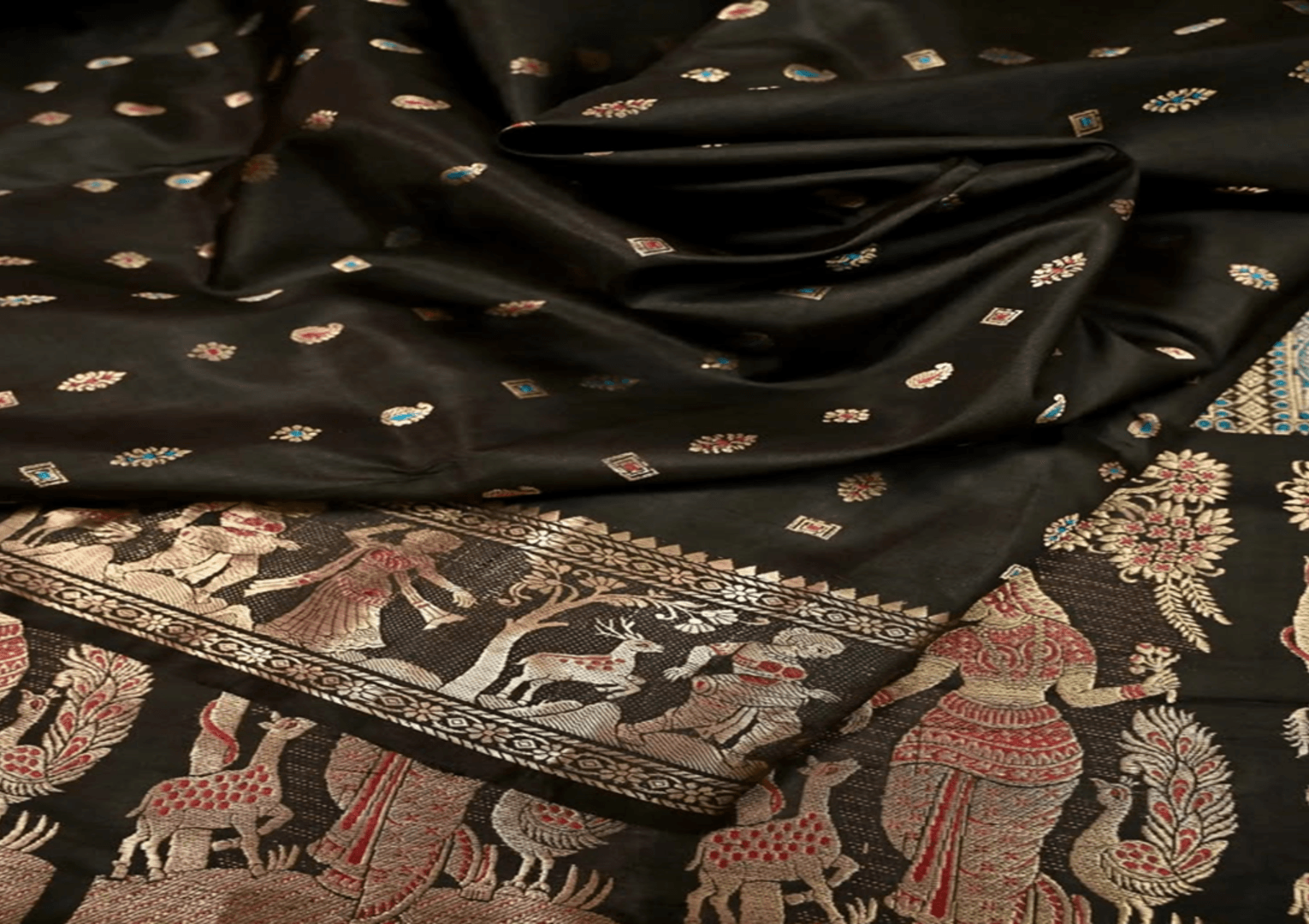
Nearly 200 years ago, in the rich heritage of Bengal textiles, the Baluchari saree was born. It originated in the quiet village of Baluchar, from which it derives its name. With the patronage of Nawab Murshid Quli Khan, the craft found its early grace.
Then, nature intervened. A devastating flood in the Ganga River submerged Baluchar. The village disappeared, but the art endured — it found a new home in Bishnupur.
Rise, Decline, and Revival
In Bishnupur, during the reign of the Malla dynasty, Baluchari weaving did more than survive; it thrived.
Years passed. During British rule, political and economic challenges led to its decline. Artisans abandoned the craft, and the looms fell silent.
Until 1956.
Subho Thakur, along with Akshay Das and Shri Hanuman Das Sarda, revived the legacy. The introduction of Jacquard weaving gave Baluchari a new voice.
The Craft and Styles of Baluchari Sarees
Traditionally, the Baluchari saree is woven in fine Mulberry silk, valued for its soft texture and rich finish. Each piece takes one to two weeks to complete, depending on the intricacy of the design.
Bengali artisans create three distinct styles of Baluchari silk sarees, each defined by their weaving technique and visual richness:
- Resham Baluchari Saree — The classic form, where motifs are woven in a single-colour silk thread, creating a refined contrast against the base fabric.
- Baluchari Meenakari — A more intricate style, featuring meenakari work with multi-coloured silk threads, adding depth, vibrancy, and artistic finesse.
- Swarnachari (Golden Baluchari) — The most opulent variant, woven with gold and silver zari, lending luminous elegance and a regal character to the saree.
Stories Woven in Silk
The beauty of the Baluchari saree lies in its storytelling motifs, drawn from mythology and culture:
- Ramayana & Mahabharata Katha
- Krishna Leela
- Bengali Wedding Rituals
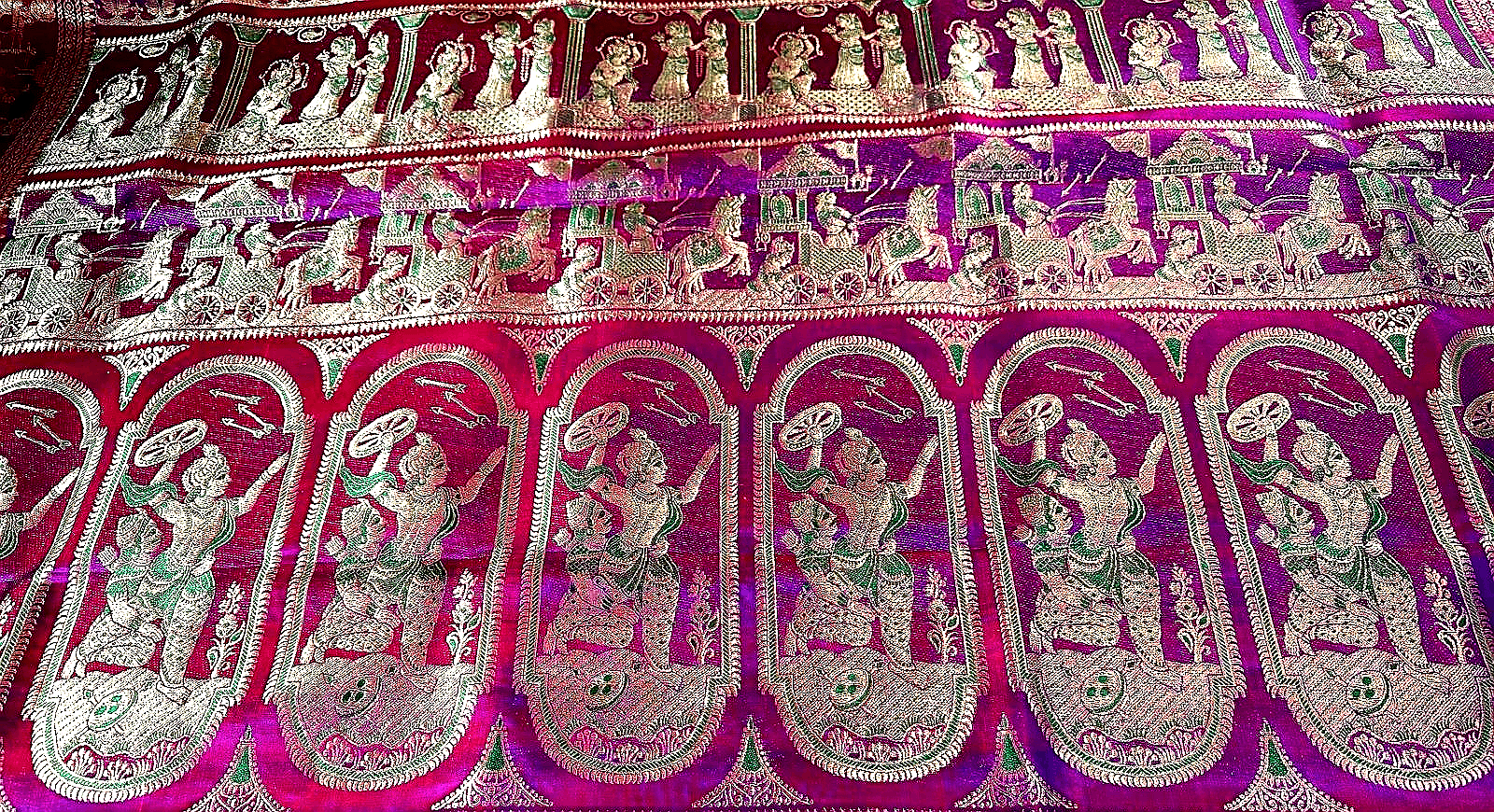
Alongside these, paisley (buta), floral, geometric patterns, and shikarga motifs add depth, rhythm, and visual richness to the weave.
Recognition
Baluchari sarees earned national recognition, winning one of the 34 National Awards for primary weaving styles in 2009 and 2010. Their distinctive craftsmanship was celebrated, aligning with the vision of "Skilling India."
In 2011, the Baluchari saree was granted the prestigious Geographical Indication (GI) tag (officially registered in 2012), securing its place as a protected and celebrated heritage craft.
In every Baluchari saree, the pallu does not decorate — it narrates. A legacy woven in silk, meant to be carried across generations.